About this course
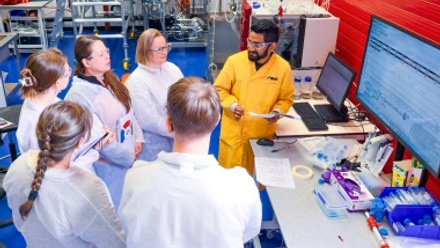
This intensive 5-day course provides a complete, end-to-end experience of the biomanufacturing workflow by integrating both upstream (USP) and downstream (DSP) operations. It is designed for professionals seeking to master the entire product journey, from initial cell culture to final purification.
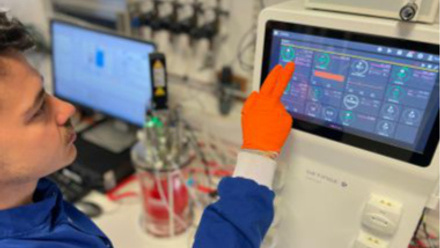
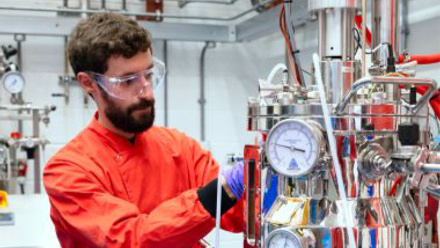
You will begin upstream by operating a 30 L bioreactor through a full microbial fermentation. You will then process your own harvest using key downstream techniques, including: centrifugation, homogenization, TFF, and chromatography to recover and purify the target protein.
By bridging the critical gap between USP and DSP, this course offers a rare, holistic perspective of the bioprocess, building the confidence to manage the complete workflow. On completion of the course, the attendees will be presented with a certificate of course completion by IBioIC.
Learning outcomes
Upon completion of this course, you will be able to:
- Execute an end-to-end upstream process by cultivating protein-expressing cells in a 30L bioreactor, covering setup, sterilisation, and real-time monitoring.
- Harvest the microbial culture and prepare biomass for downstream recovery.
- Operate a disc-stack centrifuge for cell recovery and high-pressure homogenizer to release intracellular protein.
- Apply tangential flow filtration (TFF) for buffer exchange and use chromatography systems for final protein purification.
- Use analytical methods such as SDS-PAGE to track the product and evaluate purity at critical workflow stages.
- Assess how upstream decisions influence downstream purification efficiency, yield, and final product quality.
- Develop strategies to monitor, troubleshoot, and optimize parameters across the integrated bioprocessing train.
Who will benefit?
Scientists, engineers, and technical managers involved in process integration and development, as well as specialists in either USP or DSP seeking to gain a comprehensive, end-to-end perspective.
Anyone who would like to gain an insight into the theoretical and practical aspects of bio-manufacturing.