Connecting communities from across the BIA ecosystem

In this blog, Jaime Eaton, reflects on this month's Community Connects series, bringing together diverse expertise to tackle the most pressing challenges in our sector. March brought together members from our Regulatory Affairs, Engineering Biology, Cell and Gene Therapy, Manufacturing, TechBio, IP and Finance and Tax Communities.
Our Community Connects series is the heartbeat of the BioIndustry Association (BIA), bringing together diverse expertise to tackle the most pressing challenges in our sector. Here is what happened this month:
Regulatory and Access meets BioSolutions
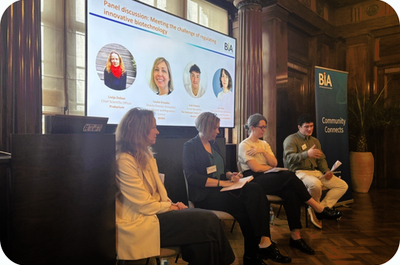
March kicked off when our Regulatory Affairs and BioSolutions communities were brought together in London on 3 March for an engaging discussion on how regulation is evolving to keep pace with advances in engineering biology. The session saw regulators and industry representatives explore how the UK can support innovative biotechnology while maintaining strong standards and public trust.
Panellists Louise Knowles, Deputy Director of Innovation Accelerator and Regulatory Science at MHRA, Jay Stone, Associate Director of External Relations and Foresight at Nuffield Council on Bioethics, and Josh Stevens, Senior Researcher at The National Centre for Social Research, shared perspectives from across regulation, ethics and social research. They discussed how current frameworks are adapting to emerging technologies, the potential role of regulatory sandboxes and how innovators and regulators can work together more effectively. The conversation also touched on the importance of engaging with ethical and societal questions early as new technologies develop. The evening finished with networking, giving members the chance to continue the discussion and connect with colleagues across the community.
Cell and Gene Therapy meets Manufacturing
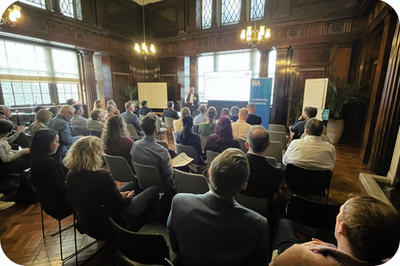
The following week, on 10 March, members of the Cell and Gene Therapy and Manufacturing communities met for a hands-on workshop on strengthening the UK’s Advanced Therapy Medicinal Products (ATMP) ecosystem. Bringing together experts from across research, manufacturing and industry, the session focused on mapping the UK’s current strengths and identifying the key steps needed to support the next generation of advanced therapies. Discussions were led by Diana Hernandez, CGTAC Vice-Chair, Angela Osborne, Founder and Executive Chair at Exmoor, Darren Blamire, CGTAC Chair, and Kit Erlebach, BIA Manufacturing Advisory Committee Chair. Participants were invited to reflect on where the UK is leading across different therapy modalities and enabling technologies, and where further collaboration, infrastructure and investment will be needed.
Conversations covered everything from clinical research strengths and partnerships between academia and industry, to manufacturing capacity, funding models and the role of CDMOs in supporting scale-up. Insights gathered during the workshop will feed into the work of the Medicines Manufacturing Industry Partnership high potential modality task and finish group, helping to inform future policy thinking and support a stronger environment for ATMP development and manufacturing in the UK. The session also provided a valuable opportunity for members from both communities to exchange perspectives and build new connections.
TechBio meets IP
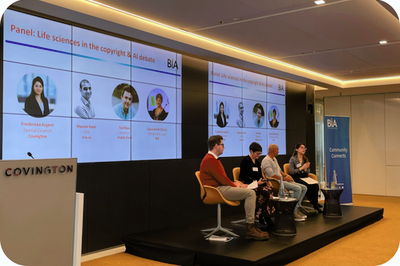
Soon after, on 12 March, the TechBio and IP communities had a timely discussion on how the UK’s copyright regime is shaping innovation in the life sciences sector. The session brought together Claire Smith, Bristows and IP Data & AI lead at BIA, Fredericka Argent, Special Counsel at Covington, Manish Patel, CEO of Jiva.ai, and Neil Ross, Director at Public First, to explore the opportunities and risks linked to text and data mining (TDM) and AI adoption. The discussion highlighted the need for clearer regulatory guidance, with panellists warning that ongoing uncertainty could slow innovation and impact UK competitiveness. While licensing models and global alignment were seen as potential solutions, concerns remain that delays in policymaking may widen the gap between the UK and more permissive markets.
A week after the event, the Government published its next steps on Copyright and AI, stepping back from its proposed ‘opt-out’ approach and instead outlining further consultations and workstreams. BIA will continue to engage closely in this area through its TechBio and IP communities.
Finance and Tax
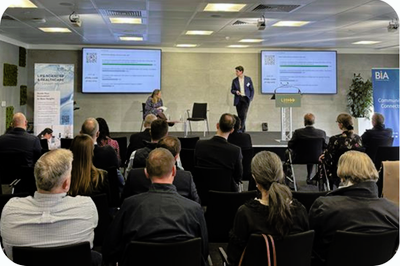
BIA’s Finance and Tax Community convened on 19 March for a discussion to explore the challenge of scaling life sciences companies in the UK. The session, led by Martin Turner, Director of Policy and External Affairs at BIA, and Melissa Strange, Chair of Finance and Tax Advisory Committee, set the scene for BIA’s forthcoming scale-up report, highlighting the struggle the UK faces in keeping scaled companies on UK shores, despite its word-leading life science sector.
Through a facilitated discussion and live polling, attendees shared insights on what defines a scale-up, which companies can fill the critical ‘middle tier,’ and how to ensure growth delivers long-term value to the UK economy. Conversations also focused on the role of government support and the conditions needed to retain scaling companies in the UK. The session concluded with networking over canapés, enabling continued exchange of perspectives and strengthening a coordinated, sector-wide approach to improving access to scale-up finance.
Want to get involved?
Join the BIA Skills Community on 12 May for Community Connects: Exploring the Life Sciences Job Plan, where we will discuss the forthcoming Life Sciences Jobs Plan and what it means for the sector. Bringing together SMEs, industry leaders and policy representatives, the session will explore current challenges in the skills and talent pipeline and provide an opportunity for members to share insights on how the UK life sciences workforce can be strengthened.