
All-Party Parliamentary Group (APPG) for Life Sciences

The All-Party Parliamentary Group (APPG) for Life Sciences exists to raise awareness and understanding of the valuable contribution the life sciences sector provides to the health and wealth of the nation. It runs topical events in Parliament on key issues affecting the sector.
APPG Officers

Kit Malthouse MP
The Rt Hon Kit Malthouse is the Conservative MP for North West Hampshire, and has been an MP continually since 7 May 2015. He is a member of the Science, Innovation and Technology Committee, and co-chairs the Choice at the End of Life APPG.

Baroness Morgan of Drefelin
Delyth Morgan, The Baroness Morgan of Drefelin, has been a member of the House of Lords since 2004 and is also Officer for the APPG on Stem Cell Transplantation and Advanced Cellular Therapies. She was previously the Chief Executive of Breast Cancer Now, the UK's largest breast cancer charity.

Pippa Heylings MP
Pippa Heylings is the Liberal Democrat MP for South Cambridgeshire, and has been an MP continually since 4 July 2024. She currently undertakes the role of Liberal Democrat Spokesperson (Energy Security and Net Zero).

Sadik Al-Hassan MP
Sadik Al-Hassan is the Labour MP for North Somerset, and has been an MP continually since 4 July 2024. A community pharmacist by background, he is also vice-Chair of the Pharmacy APPG.
Meetings and Events
Life Sciences Sector Plan One Year On: Realising the UK's Life Sciences Growth Ambition (July 2026)
Life Sciences Sector Plan One Year On: Realising the UK's Life Sciences Growth Ambition
One year after the publication of the Life Sciences Sector Plan, the All-Party Parliamentary Group (APPG) for Life Sciences brought together a panel of key leaders from across the sector to celebrate progress so far, identify key areas of focus for the future and discuss how to work together to deliver on the ambitions of the Plan.
The Government has set ambitious targets to make the UK the leading life sciences economy in Europe by 2030 through increased commercial R&D investment, greater access to scale-up capital, faster patient access to innovation and higher levels of foreign direct investment. The introduction of clear delivery metrics, accountable leadership and ambitious reforms has created positive momentum, with notable progress in regulatory reform, manufacturing investment, clinical trial performance and the development of the Health Data Research Service. These achievements demonstrate that government has successfully established the policy foundations for growth. However, these reforms have yet to deliver the system-wide transformation required to position the UK as the world's leading destination for life sciences investment and innovation.
While policy has advanced significantly over the past year, the panel discussion highlighted that the greatest challenges now lie not in strategy but in implementation. In particular, slow and inconsistent adoption of innovation across the NHS, insufficient support for commercialisation, and a narrow approach to assessing the value of health investment risk limiting both economic growth and patient benefit.

NHS Adoption Must Become a Growth Priority
The strongest theme throughout the discussion was that slow and inconsistent adoption of innovation across the NHS remains the greatest barrier to the UK's life sciences ambitions. The Government has committed to making the UK one of the three fastest countries in Europe for patient access to medicines and medical technologies by 2030. Achieving this ambition will depend not only on regulatory performance, but on addressing the longstanding barriers to adoption within the NHS.
While the UK continues to produce world-leading science, patients are often slow to benefit from new medicines, diagnostics and technologies, weakening the UK's attractiveness as a place to invest. Participants argued that faster adoption requires stronger national leadership, clearer accountability and procurement systems that reward innovation. The Budget should therefore support measures that accelerate the uptake of proven technologies across the NHS, providing greater certainty for innovators while improving outcomes for patients.
Recognising Health as an Economic Investment
A recurring message was that government should take a broader view of the value generated by health innovation. Current approaches often focus on immediate healthcare costs rather than recognising the wider economic benefits of innovation, including higher productivity, increased labour market participation, reduced long-term public spending and greater inward investment.
As one of the UK's highest-value sectors, life sciences should be recognised as a driver of economic growth as well as improved health. HM Treasury should ensure that future investment decisions better reflect these wider economic impacts.
Strengthening the UK's Commercial Environment
The Sector Plan commits to making the UK Europe's leading destination for commercial life sciences R&D investment and foreign direct investment by 2030. The discussion highlighted the need to create a more competitive environment for investment and commercialisation. Although the UK has a strong scientific base and a globally respected regulatory system, many innovative companies continue to face difficulties accessing the capital and support needed to scale domestically. As a result, promising research is too often commercialised overseas.
The Government has also committed to making the UK Europe's leading destination for life sciences scale-up capital by 2030. While investment into UK biotech has strengthened, the government should strengthen support for commercialisation, scale-up finance and translational research, ensuring that the UK captures the economic benefits of its world-leading science.
Building on Clinical Trial Success
The Government has already established a clear vision through the Life Sciences Sector Plan and committed to ambitious, measurable targets for commercial R&D. Participants welcomed the progress made in improving clinical trial performance but agreed that greater ambition is now required. Patient recruitment remains a significant weakness and continues to limit the UK's competitiveness. Better use of NHS data, digital infrastructure and the forthcoming Health Data Research Service offers an opportunity to transform research delivery and attract further global investment.
Continued investment in research infrastructure and workforce capability will be essential if the UK is to become a global leader in commercial clinical research.
Conclusion
The panel discussion highlighted that future success will depend less on new strategies and more on creating the conditions that allow innovation to be adopted more quickly, research to be commercialised more effectively and investment to flourish.
The life sciences industry is uniquely placed to support the Government's missions on economic growth, productivity and public service reform. Investment in research, innovation and adoption should therefore be recognised not solely as health expenditure, but as a long-term investment in national prosperity. The upcoming Budget should provide a framework that enables the UK to capitalise on its world-leading science, strengthen its international competitiveness and deliver greater value for patients, the NHS and the wider economy.
Building a Health Data Research Service to Benefit All (March 2026)
Building a Health Data Research Service to Benefit All
The All-Party Parliamentary Group (APPG) for Life Sciences convened a breakfast roundtable to consider the scale of health data now generated in the UK and the opportunity this presents. As the Chair noted, our health is heavily surveilled; the question is what should be done with the resulting data. The UK collects a great deal of data but does not use it effectively, and the new Health Data Research Service (HDRS) carries the hopes of many parts of the health system. Realising the opportunity will depend less on the strength of the data offer than on public trust, legislative clarity and the ability to make good practice the norm rather than the exception.
Our expert speakers laid out positive use cases and promising opportunities

Tamsin Morris (AstraZeneca) gave two illustrations of how industry can use health data. During the pandemic, AstraZeneca and the University of Oxford were given permission to use population-level NHS data to run a vaccine effectiveness and safety programme — a national-scale example of evidence generation for public good. A second programme, with the University of Hull, linked primary care records to hospital data to evaluate asthma management, improving health system efficiency and the management of chronic disease.
Cathie Sudlow highlighted that the UK collects a great deal of data but does not use it effectively, and that the ability to access it has slipped since the pandemic. Datasets are considerably more valuable when linked: linkage at population scale allows patterns to be identified and rare events detected, including the origins of adverse effects of vaccines. The RECOVERY trial, with 50,000 patients followed up through data rather than direct patient contact, was highly efficient and drove global health policy — but remains the exception rather than business as usual.
Caroline Dalton (MS Society) introduced the MS Register, established in 2011, which gathers data from 40 NHS sites with 50,000 people enrolled and 20 people living with MS shaping how it is run. It provides secure data access, analytical tools and linkage capability, and participants can view their own data and flag significant changes with their healthcare providers. The Register has shaped guidance from the National Institute for Health and Care Excellence and accelerated trials, including the Octopus trial, with future ambitions in genomic data and industry engagement.
Melanie Ivarsson noted that the HDRS carries the hopes of many parts of the health system. It is required to be self-funding by 2030 and must rapidly build its technical infrastructure, with the intention of completing that build by 2028. Patients are the north star of the work, and the ambition is for data access approvals to be faster than trial approvals: approval can be secured within weeks for a new investigational product never before used in humans, yet accessing an existing dataset can take years. This is only possible with public trust.
Public trust is the foundation
We then opened the discussion to the room, starting with why patients are the "North Star" of HDRS. When patients and the public are engaged, most are keen for health data to be used for their own benefit and that of society, provided they know it is being used for good — the starting point is considerably better than is often assumed. People often opt out without a clear understanding of what they are opting out of, and public confidence took a knock during the pandemic where data was not seen to be used correctly. The HDRS should help people understand how data use improves outcomes, as quickly as possible, with patient and public involvement woven through the programme.
Securing Legislative Clarity on the Single Patient Record

A specific ask arose for parliamentarians. The Single Patient Record (SPR), being explored by NHS England to connect primary and secondary care records, could act as an enabler for the HDRS, but it is not currently clear that it could be used for secondary purposes. If the forthcoming legislation is silent on whether it covers secondary uses, this risks foreclosing legitimate research uses and creating a public confidence problem later. Parliamentary support will be needed to understand the interaction between the SPR and the HDRS, and to ensure the legislation is clear on secondary uses when it comes forward.
Competitiveness, Curation and SMEs
Justifying investment in UK research and development is difficult when other jurisdictions are easier to work in. The HDRS is itself a reason to invest — the UK holds valuable data it has not been effective at bringing together — but companies want speed and certainty, and industry does not simply want access to data; it wants curation. The points of failure need to be identified precisely: for example one SME at the table said they do not run trials in the UK because it is too difficult, with patient populations hard to access and contracting with individual trusts burdensome, while a trial can be set up in the United Arab Emirates within 60 days along a joined-up patient pathway. Ensuring UK small and medium-sized enterprises are not placed at a disadvantage will require change across policy, regulation, NHS systems and market access.
Conclusion
The UK's position is genuinely unusual, with a real opportunity to demonstrate what is possible: bringing industry through the door on the strength of the data offer, then persuading firms to run their trials here through an agile regulator, innovative approval mechanisms and the NHS as a single point of entry. As the Chair observed, there is a generational difference in sensitivity to data use, and once the door is opened on a technology things accelerate very quickly — so we must be ready.
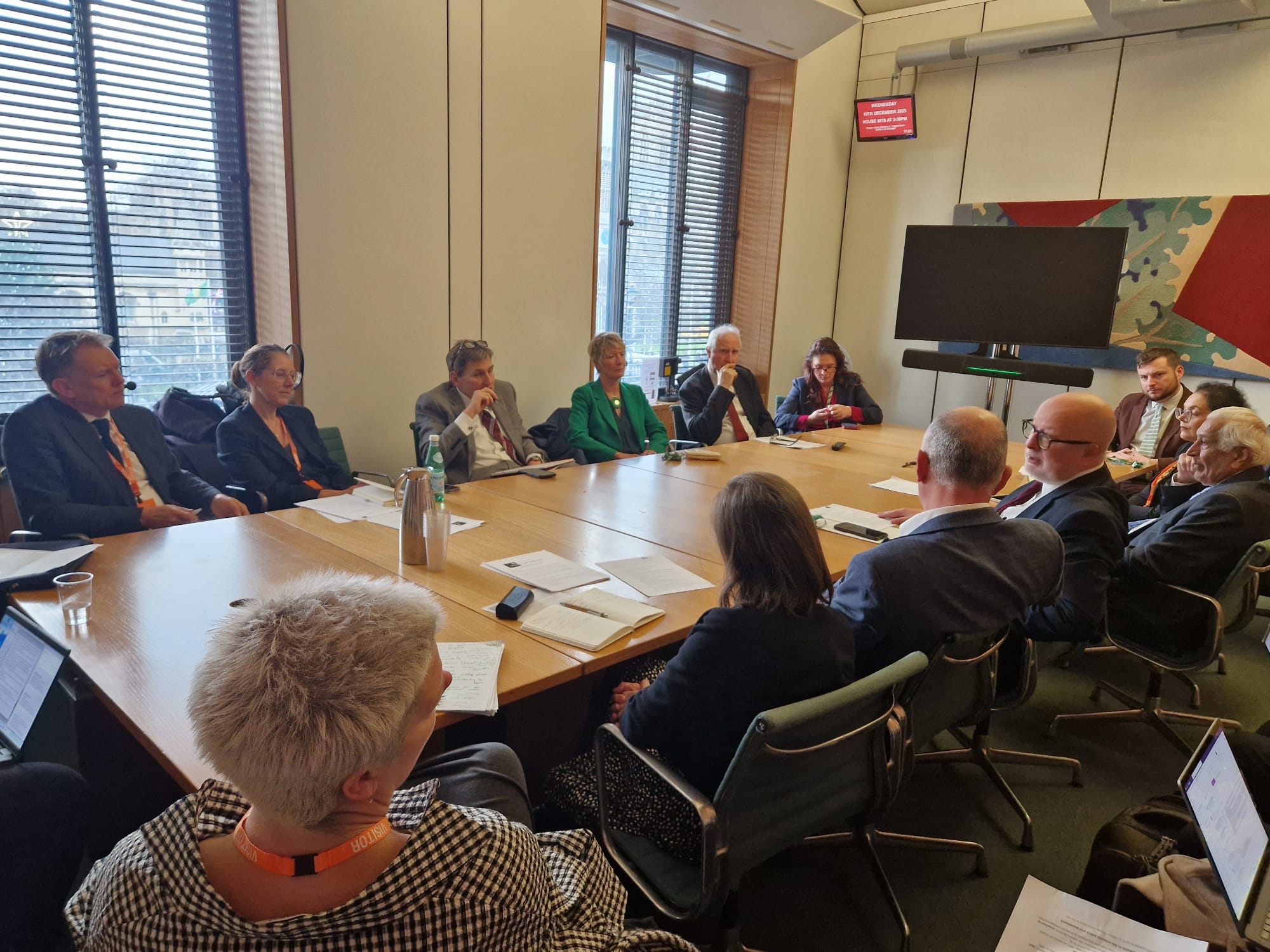
Is the UK’s life sciences environment competitive enough? (December 2025 (AGM))
The APPG held its AGM in Demcember 2025, followed by a roundtable to explore, 'Is the UK’s life sciences environment competitive enough?'.
The session covered reactions to the Autumn Budget and examined the key drivers shaping the UK’s ability to compete internationally, particularly in light of recent evidence given to select committees, the UK-US deal, and concerns raised about pricing, uptake and access for medicines and technologies.
There was cautious optimism. Recent policy moves have helped reset sentiment, and initiatives like Health Data Research Service point in the right direction. But delivery is what counts. As one delegate put it: if patient outcomes aren’t different and uptake hasn’t improved in two years or so, then we’re not doing enough.
Access the meeting minutes, income and expenditure statement, due diligence statement and annual report.

From Bedside to Breakthroughs: Embedding clinical research as a core part of NHS practice (July 2025)
From Bedside to Breakthroughs: Embedding clinical research as a core part of NHS practice

On the day the Life Sciences Sector Plan was published, and just days after the launch of the NHS 10 Year Health Plan, we held the second in a new series of parliamentary roundtables. The timing offered a perfect opportunity to raise the pinch points and enablers for the plans’ successful delivery.
In a timely and wide-ranging discussion, participants agreed that research must be seen as a core NHS function, not a ‘nice to have’. They highlighted the need to address the decline in clinical academics and support a research-active and research-aware workforce. Ensuring diverse patient participation in studies and tackling system fragmentation were seen as essential to accelerating innovation. The discussion also underlined the importance of improving access to private finance and venture capital, harnessing the UK’s strengths, and identifying how parliamentarians can help turn ambition into action.

Speakers and contributors included Kit Malthouse MP, Emily Darlington MP, Steve Yemm MP, Kevin Bonavia MP, Chief Scientific Adviser Lucy Chappell, Dr Sonya Babu-Narayan, Dr Kam Pooni, and representatives from the group’s secretariat.
Aligning Charities, Industry, and Academia for a Unified Life Sciences Sector Plan (April 2025)
Aligning Charities, Industry, and Academia for a Unified Life Sciences Sector Plan
The All-Party Parliamentary Group (APPG) for Life Sciences convened a roundtable to consider how charities, industry and academia can align behind a unified Life Sciences Sector Plan. Life sciences has been identified as a key sector and a priority for the current and previous governments — likened by the Chair to the financial services sector — yet despite this priority there has been no significant paradigm shift in addressing the industry's challenges. The Sector Plan, developed alongside the 10-Year Health Plan, offers an opportunity to change that. Realising it will depend less on strategy than on accountability, ownership and practical implementation, and on getting the entire ecosystem to operate differently: not one institution is solely responsible, and all parts of the system need to align.
The View from Across the System
Our expert speakers set out the sector's strengths, its persistent weaknesses and what the Plan must deliver.
Roz Campion (Office for Life Sciences) reported that the Sector Plan is being developed alongside the 10-Year Health Plan, with a key challenge in properly integrating the health system with the Plan. Reflecting on past sector plans, she noted that while much good work has been done, none have fulfilled their potential due to high-level or imprecise wording, lack of clarity on accountability and ownership, and an absence of specifics on practical implementation. Following consultation with around 250 organisations, the Plan is expected around the beginning of June with clear funding announcements, focused on world-class R&D, making the UK an outstanding location to grow, scale and invest, and driving health innovation by disrupting the system — recognising that the Government cannot do this alone.
Joe Edwards (ABPI) argued that the UK is at a crucial moment, and that getting the interplay between the Industrial Strategy, the Sector Plan, the NHS 10-Year Plan and the Trade Strategy right is essential. The UK's strengths include research excellence — the highest intensity of publications in the top 1% most cited medical sciences globally, second only to the US in universities — alongside robust intellectual property protections. But red flags remain: slow adoption of innovation, the lowest spend on medicines in the G7 with the highest clawback rates, and lagging Phase III trial performance. Getting the data environment right could create 70,000 new jobs or more, with around half the opportunity ($163 billion) in clinical trials; international competition is unprecedented, and the UK cannot afford an inward-looking strategy.
Melissa Strange (EnteroBiotix; Chair of BIA's Finance and Tax Advisory Committee) discussed the challenges faced by smaller biotech and medtech spin-outs, which struggle to raise funds and scale, particularly around manufacturing. While the UK accounts for about 40% of European biotech venture investment each year, it lags behind the US at the scale-up stage, and pre-revenue biotechs reliant on successive funding rounds are finding them harder to secure. Access to finance must be a priority in the Plan — pushing through the Mansion House compact, recognising that 65% of medicines in global clinical trials are being developed by smaller biotech, and providing stability in R&D tax reliefs that fund science rather than financial advisors.
Eoin McKinney (University of Cambridge) highlighted a paradigm shift in access to data and its far greater potential now, benefiting patient care and medical research. The UK has vast data resources, but regulatory and access barriers prevent their full use — it takes 12 months to access data on his own patients held by the NHS. National Trusted Research Environments are more useful than regional ones and need to be implemented faster; standardising and linking data across pharmacy, GP and hospital sources requires investment; and training in data science, spanning multiple disciplines, is essential to harness the potential.
Owen Jackson (Cancer Research UK) set out the vital role of the third sector, noting that CRUK spent £400 million on research last year, comparable to a mid-sized pharma firm. The UK relies on such organisations to deliver life sciences, yet the third sector is underfunded compared with the US, where per-capita research spending is nine times higher. He emphasised the need for co-location between government, the third sector, the NHS and industry — citing the South Cambridge development — and called for blockers such as Horizon funding access, data availability and trial paperwork to be addressed.
Aligning the Whole System
The strongest theme was the need for a more joined-up approach across government, academia, industry and charities to unlock the sector's potential. Aligning the entire ecosystem requires many organisations to contribute and take accountability, implying a significant shift: not one institution is solely responsible, and all parts of the system need to operate differently. Co-location between government, the third sector, the NHS and industry was seen as central to fostering that collaboration.
Closing the Funding Gap
Increasing funding and support for smaller biotech and medtech companies to help them scale up was highlighted as critical. While the scale of Innovate UK funding is welcome, it was noted as insufficient for later-stage clinical development — tens rather than the hundreds of millions needed to move from Phase II to Phase III — unlike new initiatives in the US and EU. Something is needed to capture the funding gap in this "middle ground", beyond early-stage SEIS and EIS funding.
Metrics and Accountability
Metrics and accountability will be critical for measuring success. Proposed metrics included the number of days to set up clinical trials (targeting 150 days), registered patents, R&D tax credit usage per year, and the number of PhD students including progression and drop-off. Metrics on NHS trusts linked, access to new treatments, variation and uptake of NICE-approved treatments were also discussed, alongside the need to capture the "middle ground" funding stage.
Conclusion
International competition is like never before, and the regulatory environment outside the EU presents an opportunity for speed — single approval processes, improved set-up times and investment in the enablers to roll out innovation. The creation of the national Health Data Research Service is aimed at coordinating efforts on the 'data problem' and simplifying secure access to de-identified NHS data for research. As the Chair concluded, clinical trials are a key lever that drags other important things in their wake.


Secretariat
The APPG Secretariat is managed by a collection of charities, trade bodies and an academy within the life sciences sector. These organisations reflect the breadth of the sector. The full Secretariat membership is the BioIndustry Association (BIA), the Association of Medical Research Charities (AMRC), the British Heart Foundation, The Association of the British Pharmaceutical Industry (ABPI), the British In Vitro Diagnostic Association (BIVDA), the Academy of Medical Sciences, Cancer Research UK and Arthritis UK.
This is not an official website of Parliament. It has not been approved by either House. APPGs are informal groups of Parliamentarians with a common interest in particular issues. The views expressed are those of the group.