
Future-proofing labs by connecting safety, science and data
What future-proofing means in regulated scientific environments

Zareh Zurabyan
VP of GTM & Enterprise Solution Architecture, SciSure
In biotech, pharma and healthcare, the phrase 'future-proofing' typically refers to adopting emerging technologies, modernising workflows, or experimenting with AI-driven analytics. Yet in regulated scientific environments, future-proofing has a far more specific and structural meaning.
Future-proofing a laboratory means designing its operational and data architecture so that it remains resilient, compliant, adaptable and strategically relevant under accelerating technological change, regulatory evolution and organisational growth. It is not about anticipating the next tool. It is about eliminating structural weaknesses that will eventually limit scale, innovation and trust.
In 2026 and beyond, those weaknesses increasingly stem from one root cause: the separation of safety systems, research systems and data infrastructure.
The illusion of digital maturity
Most enterprise laboratories are digitally enabled. Experiments are documented in ELNs, samples move through LIMS, quality systems enforce procedural controls and EHS platforms track hazards, training and incidents. Advanced organisations layer analytics or early AI capabilities on top of this foundation.
From a tooling perspective, the lab appears modern.
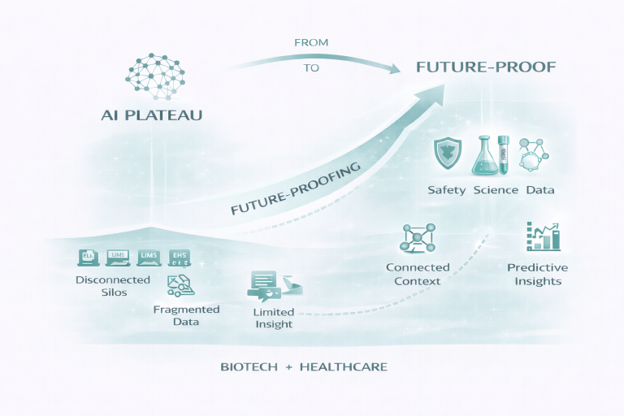
However, modernisation is not the same as integration. In many organisations, these systems function as parallel domains rather than as components of a unified operating environment. Each platform captures information according to its own logic, governance model and data definitions. Integration, where it exists, is often transactional rather than structural.
The result is subtle fragmentation. Safety data is recorded but not deeply connected to experimental lineage. Training records exist but are not embedded into execution workflows. Environmental conditions are documented but not structurally tied to materials, protocols and outcomes in ways that allow learning to accumulate.
This separation rarely creates immediate failure. It creates long-term constraint.
Key Takeaway: Digital enablement without architectural integration creates hidden fragility. A lab may appear modern while remaining structurally constrained.
Why safety, science and data cannot remain separate
Safety governs the conditions under which research occurs.
Science generates knowledge.
Data determines what knowledge can be retained, analysed and reused.
Treating these domains as independent may appear administratively efficient, but it introduces architectural friction.
When safety systems operate outside the research workflow, compliance becomes reactive rather than continuous. When scientific outputs are detached from operational context — such as training status, environmental exposure, or hazard classifications — datasets lose explanatory depth. When data architecture does not incorporate safety and research metadata as part of a shared model, analytics and AI initiatives operate on partial representations of reality.
This matters because modern scientific enterprises are increasingly dependent on cross-domain intelligence. Insight no longer emerges from isolated experiments alone; it emerges from patterns across experiments, environments, personnel and operational conditions. If those contextual layers remain disconnected, institutional intelligence cannot compound.
Key Takeaway: Futureproofing requires connecting safety, science and data within a shared architectural framework. Without integration, intelligence remains fragmented.
Risk reduction and operational efficiency share the same architecture
A persistent misconception in regulated environments is that increasing safety controls inevitably introduces operational friction. In practice, both risk and inefficiency originate from the same source: structural separation.
Fragmented systems increase risk because investigations require reconstruction of context across platforms. They increase friction because teams must reconcile inconsistencies manually. Audit preparation becomes episodic rather than continuous. Research delays arise from administrative ambiguity rather than scientific uncertainty.
When safety data is embedded directly within research workflows, ambiguity decreases. Training compliance functions as an operational gate rather than a retrospective checklist. Hazard metadata travels with materials and protocols. Incident data informs experimental design instead of remaining isolated in reporting logs.
In such environments, compliance ceases to be episodic. It becomes infrastructural. Risk declines because context is preserved. Friction declines because context does not need to be rebuilt.
Key Takeaway: Architectural coherence reduces risk and friction simultaneously. Integration is not a tradeoff between safety and speed — it is the condition that enables both.
AI raises the bar for what 'future-proof' means
The rise of artificial intelligence fundamentally changes the definition of futureproofing. AI systems do not reason about static documents; they depend on structured, interoperable and context-rich data relationships. They require consistent metadata, lineage and cross-domain visibility.
If safety and environmental data exist outside the research data graph, AI models interpret experiments without understanding the conditions under which they occurred. If training records, equipment states and hazard classifications are not integrated into the broader architecture, predictive systems generate incomplete or misleading conclusions.
Organisations may deploy AI tools under fragmented conditions. They may demonstrate isolated improvements. But they will not build sustainable AI capability.
Long-term AI value depends on data cohesion, not model experimentation. AI does not merely introduce a new capability; it exposes the weaknesses of disconnected systems.
That’s one reason why we built the SciSure MCP - to leverage AI on structured data with guardrails fully in place. Users have role and permissions-based access to data for immediate insights and automated workflow management. The purpose is to give AI as useful and connected a foundation to work on, so context is always maintained and relevant to daily work.
Key Takeaway: In the AI era, futureproofing depends on architectural integration. AI rewards coherence and amplifies fragmentation.
Scale and M&A expose structural design choices
Structural separation also becomes visible during expansion and acquisition. As organisations grow or integrate new entities, differences in safety systems, compliance workflows and data models quickly surface. Reconciliation becomes costly when safety and research domains were never architecturally aligned.
Organisations that have integrated safety, science and data within a shared framework are better positioned to absorb complexity. Growth does not require rebuilding foundational models. Integration becomes alignment rather than reconstruction.
Futureproofing, in this context, is not about anticipating regulatory shifts. It is about ensuring that the laboratory’s core architecture can absorb change without introducing instability.
Key Takeaway: Integration is a scalability multiplier. Fragmentation becomes exponentially expensive under growth and M&A pressure.
From compliance function to control layer
When EHS operates as a standalone system, it functions primarily as a reporting and documentation mechanism. When embedded within the broader lab architecture, it becomes a control layer.
A control layer stabilises execution by ensuring that materials, personnel, environments and processes operate within defined parameters. It maintains continuous traceability. It integrates risk metadata into experimental context. It strengthens reproducibility and defensibility.
In this model, safety is not an external obligation imposed on research. It is part of the infrastructure that enables research to scale responsibly.
Key Takeaway: Safety embedded into architecture becomes infrastructure, not oversight.
The strategic imperative
For leaders in biotech, pharma and healthcare, the question is no longer whether safety, research and data systems should exist. It is whether they are architected to function as one ecosystem.
Futureproofing requires acknowledging that AI acceleration, regulatory scrutiny, operational scale and competitive pressure will only intensify. Under those conditions, disconnected systems become liabilities. Integrated architectures become strategic assets.
Organisations that connect safety, science and data reduce risk and friction simultaneously because both originate from structural separation. They improve audit defensibility while accelerating execution. They strengthen AI readiness while enhancing day-to-day operational clarity.
Relevance in the coming decade will not be determined by how many tools a lab adopts. It will be determined by whether its systems are designed to operate coherently under pressure.
Futureproofing is not a technology decision.
It is an architectural decision.
And architecture determines what scales.
This is a guest blog. Its author is responsible for content within it, which does not necessarily reflect the opinions or positions of BIA.