Lab of the Future: Discovery Park event brings together 140 life science leaders
Industry leaders gathered at Discovery Park on 14 October for The Lab of the Future & Green Chemistry Innovation, an event exploring pharmaceutical AI, automation and green chemistry, with speakers urging the industry to unite to share learnings and knowledge.
The half-day event drew 140 delegates from pharma, biotech, research and manufacturing for keynotes, panel discussions and a fireside chat.
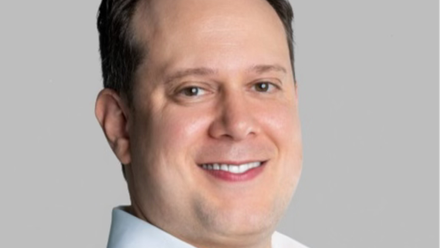
Abbie Kempe, Director of Research, Enterprise & Innovation Services at Canterbury Christ Church University, chaired the event. Discovery Park's CEO, Mayer Schreiber, opened the day by tracing AI's disruptive journey from his first ChatGPT encounter in 2022 to the powerful agentic lab ecosystems transforming automation today.
In his keynote, Steve Fussell, Senior Manager – High-Throughput Experimentation Lead in Chemical Research & Development at Asymchem, explained how high-throughput experimentation and automation can reshape pharmaceutical R&D and manufacturing. He noted: “By unlocking efficiency with robotic systems, we are making transformation improvements in speed, precision and time utilisation. This is freeing up our brilliant scientists to focus on transforming data into knowledge.”
Mark Fish, Vice President and General Manager – Digital Science and Automation Solutions at Thermo Fisher Scientific, discussed the acceleration of autonomous labs. He said:
All the tech in the world won’t make your lab faster unless you take your scientists on the journey with you. We need to equip scientists with training, allow for experimentation, and encourage them to get practical, using tools to solve hands-on problems. We need a hybrid workforce with skills in both science and AI technology, and importantly we need to give this workforce time to learn.
Insights were also shared from Thomas Balkizas, Senior Director, R&D Industry Advisory for Healthcare and Life Sciences at Microsoft, on agentic laboratories, with AI able to reason with scientific data, not just retrieve it. He advised SMEs to start with a single use case built around a real research bottleneck – such as literature review or candidate screening – and pilot an agentic workflow with proper governance, then apply what they learn across the organisation.
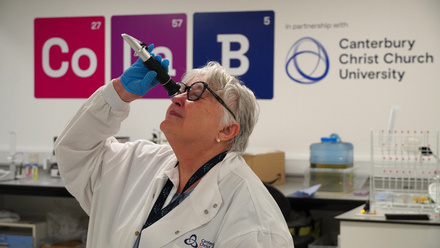
A panel on the digital lab in action brought together speakers from AstraZeneca, Thermo Fisher Scientific, the Pistoia Alliance and Canterbury Christ Church University. A second panel, with experts from Asymchem, CatSci, Growing Kent and Medway and Canterbury Christ Church University, made the case for continuous improvement and collaboration in sustainable innovation.
John Murphy of Particology chaired a fireside chat on sustainability and commercialisation with Caterina Minelli of NPL and Shashi Pandya of Pale Blue Dot and Spinnovate UK. He shared lessons from Particology’s Innovate UK-funded “Grand Challenge” research project, developing and demonstrating new technologies for greener, more efficient medicines manufacturing.
The day closed with an IP Clinic hosted by Venner Shipley, helping attendees protect and commercialise their innovations. The event was organised by Discovery Park and sponsored by Asymchem, the IChemE Pharma Group, Particology and Venner Shipley.
Exhibitors included Canterbury Christ Church University, Emerson Process Management, Haier Biomedical, Jaytee Biosciences, LAUDA Technology, Novogene, Omicron Research, R&L Slaughter, Sartorius UK, Thermo Electron Manufacturing and Venner Shipley.