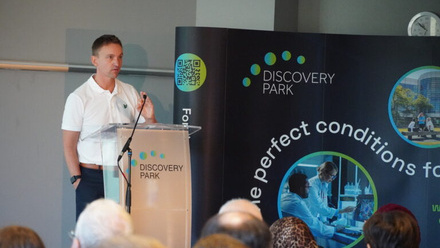
Industry leaders gathered at Discovery Park on 14 October for The Lab of the Future & Green Chemistry Innovation, an event exploring pharmaceutical AI, automation and green chemistry, with speakers urging the industry to unite to share learnings and knowledge.
Causeway Sensors and Fusion Antibodies share a case study on how TITAN’s real-time, at-line analytics detected key harvest yield differences by Day 3, enabling early process intervention and smarter resource allocation.
Chris Molloy on Mike Hoare, the RedX-Skye deal, Stablepharma’s fridge-free vaccine, MHRA quarterly numbers, ministerial responsibilities for UK life sciences and human biology-based models
The Milner Therapeutics Institute has joined the o2h Discovery Platinum Partner Programme, enabling eligible companies within its bio-incubator and wider affiliate network to access specialist drug discovery support through the o2h Kickstarter Award.
Drug Discovery 2026 returns to ExCeL London from 14–15 October to celebrate 20 years of collaboration and inclusion. Keynote programme includes presentation from Dr Sam Barrell CBE and panel discussion with Dr Anne Phelan, Dr Jason Mellad, Prof Sir Mene Pangalos and Prof Raghib Ali OBE
In this blog, Ethan Almond reflects on the inaugral BioSolutions UK conference, which brought together over 200 innovators, policymakers and industry leaders alongside an additional 29 investors.
The UK BioIndustry Association (BIA) is the UK’s trade association for innovative life sciences and the leading UK-wide forum for expert communities and high quality peer-to-peer networking in the sector.
In this guest blog, Dan Stanton, Trade Media Expert at Sartorius Bioprocess Solutions, discusses how tight funding, manual tech transfer and product specific analytics are keeping cell and gene therapies (CGTs) from realising their potential.
In this guest blog, Rubin Joshi, Business Development Manager at Aldevron, explains how scaling adeno-associated virus (AAV) manufacturing remains a major bottleneck for gene therapy development.
Outpost Bio has raised $3.5 million in pre-seed funding to build frontier AI models that make human microbiology computable, enabling more precise prediction and optimization of intervention outcomes.