
Past the plateau: what biotech's AI is waiting on
AI may be biotech’s biggest opportunity, but without the right data infrastructure, even the smartest models risk getting stuck at pilot stage

Zareh Zurabyan
VP of GTM & Enterprise Solution Architecture, SciSure
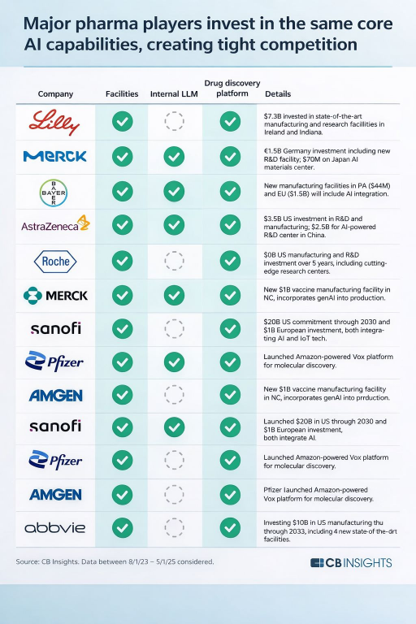
Walk into nearly any biotech, pharma, or healthcare organisation today and you'll find the same picture: AI is everywhere in theory and still finding its footing in practice.
Boards are talking about it. Budgets are shifting toward it. Conferences, webinars and white papers frame it as the next frontier of innovation. Inside most teams (from R&D to clinical development to real-world evidence), the pilots are running and the ambition is real. The step from pilot to production is the one still to be taken.
That step isn't blocked by technology. And it isn't blocked by a shortage of talent. The reason is simpler and more structural: most organisations are trying to layer intelligence on top of infrastructure that was never built to support it. Which is the encouraging part, because infrastructure is a problem we already know how to solve.
The comfortable but wrong diagnosis
When AI projects fail to scale, the post-mortem often sounds familiar:
- “The models aren’t ready yet.”
- “Regulation is slowing us down.”
- “We need more data.”
- “We need better algorithms.”
These explanations feel safe, but they’re incomplete.
Yes, regulatory complexity and data privacy concerns are real in healthcare and biotech. These factors alone have been shown to slow AI adoption in clinical settings because of trust, governance, and ethical concerns.
But they’re symptoms, not root causes.
The deeper problem is this:
AI doesn’t fail because it lacks potential; it fails because most organisations lack the data and operational infrastructure that AI actually needs.
And until that foundation is built, AI will remain an interesting experiment, not a scalable instrument of enterprise intelligence.
From 'more tools' to 'unusable data'
The life sciences and healthcare industries are awash in data. Between electronic health records, assay results, omics datasets, imaging, clinical annotations, real-world evidence, and sensor streams, there’s enough raw information to fill petabytes.
And yet:
- Data sits in silos across teams and systems.
- Formats differ wildly from one instrument or lab to the next.
- Metadata is inconsistent or missing altogether.
- Provenance (the lineage of how data was created and curated) is often undocumented.
This isn’t a new problem, but it is the reason why so many AI tools never deliver on their early promise.
A recent industry survey from the Pistoia Alliance, for example, highlights data readiness as the top obstacle to AI scaling in pharma, even as companies shift toward innovation-centric use cases.
In other words, the data is there, but it isn’t prepared for intelligence.
Why point solutions fall short
Most AI tools are excellent at solving narrow problems: image classification, natural language extraction, structure prediction, sequence annotation, assay optimisation and so on.
But AI isn’t magic, it’s context-dependent pattern recognition. Without context, AI becomes brittle:
- An assay analysis model can’t reason about protocol deviations if it doesn’t know the protocols.
- A predictive model for toxicity can’t generalise across compounds if the data lacks consistent metadata.
- A clinical decision support model can’t support practice unless it’s linked to compliant, auditable workflows.
AI tools are optimiaed for slices of the problem. Labs fail through the seams between slices between teams, data systems, and workflows. That’s where intelligence collapses.
This pattern isn’t unique to life sciences. Cross-industry research shows that governance structures and implementation frameworks are among the key factors needed to enable real adoption far more so than the novelty of the algorithm itself.
Infrastructure isn’t optional. It’s the precondition
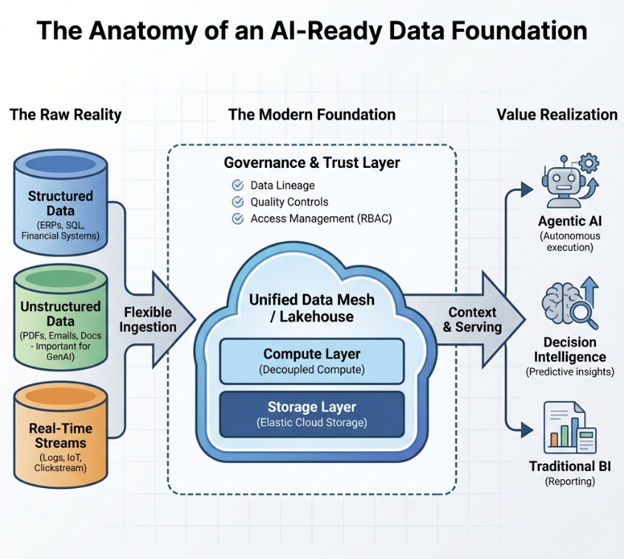
If AI is to be more than a hopeful experiment, organisations must attend to their foundations first. Multiple expert reports emphasise that AI readiness is fundamentally about building reliable data infrastructure before model deployment.
What does that look like in practice?
- Unified and high-quality data repositories, so researchers aren’t stitching together incompatible datasets.
- Common metadata standards, so AI knows what data means, not just what it is.
- Interoperable systems, so insights can travel across functions rather than get trapped in silos.
- Governance, lineage, and compliance baked into the pipeline, so AI outputs are defensible and trustworthy in scrutinised environments like clinical trials or regulatory submissions.
A data-infrastructure-first mindset isn’t glamorous. But it’s the equivalent of “fixing the plumbing” before turning on the faucet.
The AI plateau explained
It’s why we see this pattern over and over:
- A pilot shows promise in a controlled setting.
- The technology looks impressive in slides or demos.
- But when it’s time to operationalise, productionise and scale across sites or functions…
- …the initiative sputters.
This isn’t evidence that AI doesn’t work. It’s evidence that AI only works where the foundation supports it.
We see this in healthcare too. Literature shows that without trust in the underlying data and without robust implementation frameworks, AI adoption remains slow compared to other industries.
A path forward, not just hope
So, what does success look like?
It starts not with AI, but with the systems that enable AI to work:
- A lab that captures structured, semantically rich experiment records.
- A clinical research organisation where EHR, lab results, and trial metadata are harmonised.
- A pharma R&D environment where data lineage and governance are baked into every dataset.
Only then can AI models generate meaningful insights that can be operationalised across teams and functions.
Closing
AI isn’t failing biotech. Biotech is failing AI, at least in the way most organisations are trying to deploy it.
Not because the technology isn’t capable, but because they’ve built workflows, systems, and data silos first and then tried to shoehorn intelligence on top.
AI’s next breakthrough won’t come from a new model. It will come from infrastructure that makes existing models work everywhere.
And that’s a design problem, not a hype problem.
References to explore
-
BIA’s health data vision 2035: harnessing a national asset for growth
- Why AI adoption is failing in life sciences — industry insight into stalled implementations
- Guide to data infrastructure readiness for AI in biotech
- Barriers to and facilitators of AI adoption in healthcare
- Importance of data strategy for AI’s potential in pharma
- Industry analysis showing data readiness as a key obstacle in AI scaling
This is a guest blog. Its author is responsible for content within it, which does not necessarily reflect the opinions or positions of BIA.