A case-study on the TITAN antibody quantification platform
Causeway Sensors and Fusion Antibodies share a case study on how TITAN’s real-time, at-line analytics detected key harvest yield differences by Day 3, enabling early process intervention and smarter resource allocation.

Claire Smith
Partner – Commercial & IP transactions, Bristows
Rapid identification of 50% higher-producing transient CHO culture conditions using TITAN’s real-time, at-line analytics.
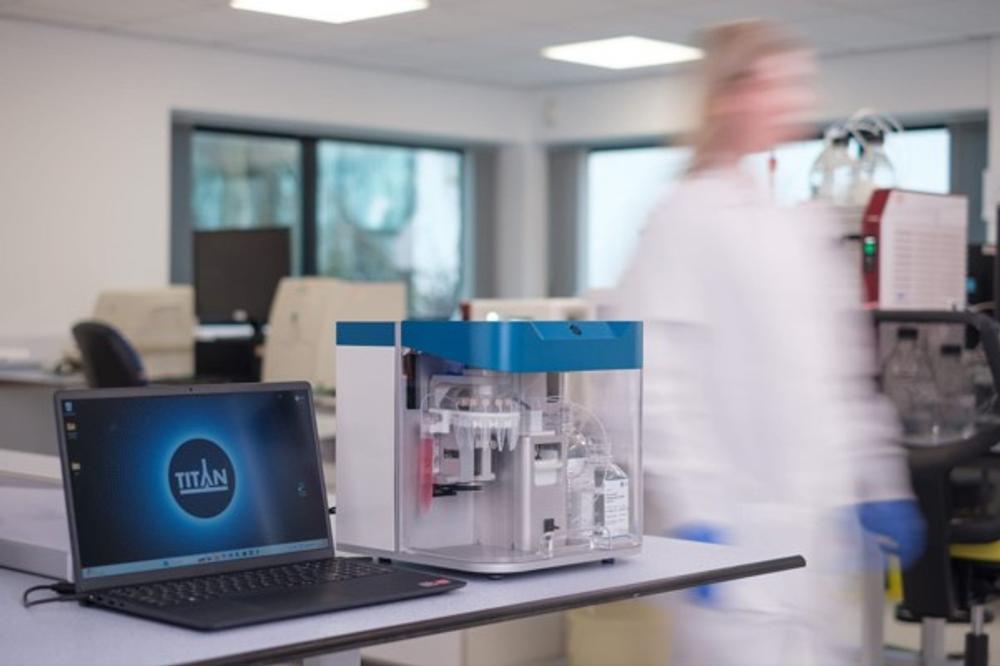
The TITAN antibody quantification platform from Causeway Sensors is designed to massively optimise your bioproduction process, providing accurate, real-time, at-line antibody quantification from crude samples.
TITAN is applicable across a wide range of bioproduction concerns, with a PrG assay commercially ready and additional assays in development, allowing it to address a number of antibody manufacturing formats. In this case study, we see TITAN applied to transient transfection of CHO cells - a crucial technique for fast, flexible scale-up of antibody generation used by Fusion Antibodies, a UK-based CRO.
Fusion Antibodies trialled the TITAN system to enable early detection of failed batches - their transient protein expression service accelerates preclinical development by screening multiple transfection conditions in parallel and the entire efficiency of this approach relies on the early identification of optimal process conditions. Unfortunately, screening large experimental matrices is a considerable burden with existing methods, such as ELISA, HPLC and BLI; moreover, even if the capacity exists, these methods are typically centralised and rely on freezing time-point samples to manage throughput, meaning results arrive delayed, limiting their efficacy in terms of optimising process conditions.
TITAN, on the other hand, allowed the cell culture team to have direct, real-time access to quantification data, giving the information needed for immediate process optimisation, without disrupting Fusion’s established upstream workflows.
From unboxing the compact TITAN system, a short series of calibration runs (guided by the user-friendly software) was all that was required to bring the instrument into operation. The cell culture team were then able to pull off small sample volumes from the culturing flasks daily and feed these directly into the fully-automated TITAN system - no dilution, centrifuging or other sample prep required - and with sufficiently small sample volumes (typically < 1 mL) so as to avoid perturbing the growth and production dynamics within the flask.
Even with the low concentrations expressed in the flasks as early as Day 3 in their run, TITAN was able to immediately provide accurate and precise results for the team’s decision making. With a wide dynamic range and excellent lower limit of detection, samples from low to medium concentrations are easily managed; for higher concentrations, TITAN performs its own internal auto–dilution to bring the samples back down into range, all without any experimental input required from the operator, making possible crude sample input straight from the source.
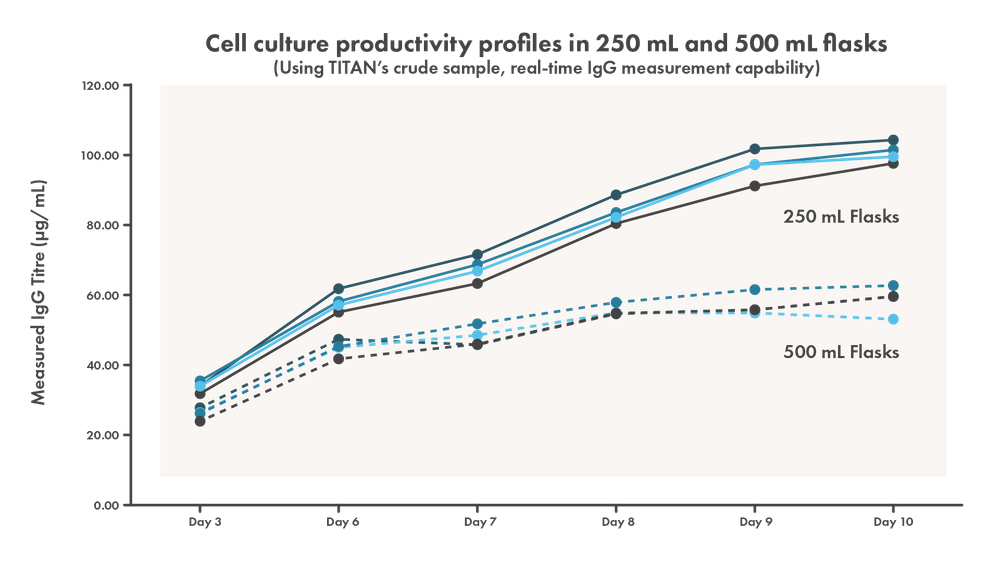
Fusion Antibodies found, using TITAN, that there was a ~50% lower IgGk harvest yield in 500 mL vs. 250 mL Thomson Optimum Growth flasks in the first transfection round and that there was a higher yield from 250 mL Corning Erlenmeyer flasks compared with both 250 mL Thomson Optimum Growth flasks and 650 mL Corning Erlenmeyer flasks in the third round. TITAN could detect these yield differences by Day 3, in real time, versus the existing Octet BLI method, which was only able to inform the process at the conclusion of the screening programme, due to resourcing required to run the BLI.
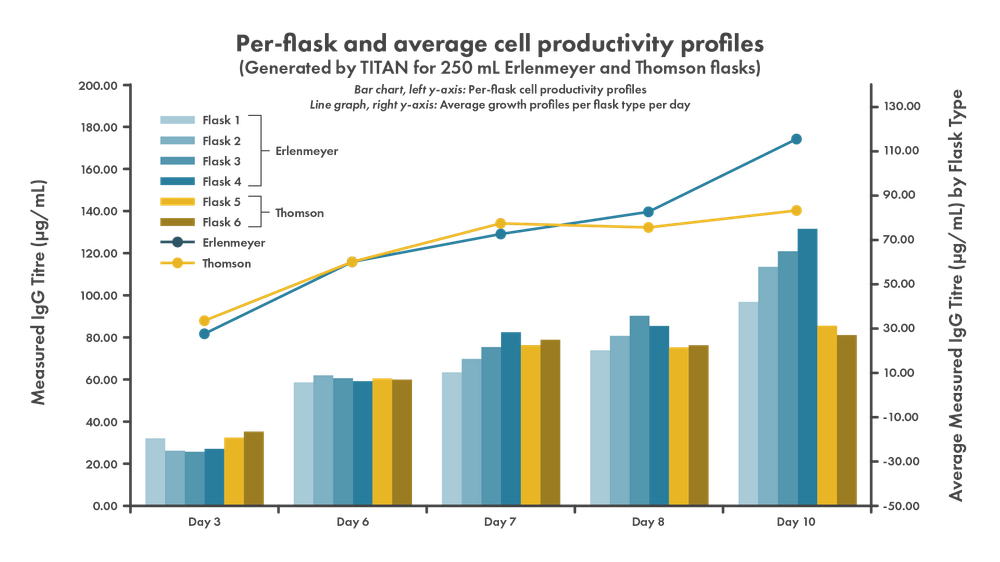
This early visibility allowed the bioprocess team to identify productivity gaps between culture conditions as early as possible in the process, enabling mid-process intervention and much more efficient allocation of development resources, paving the way to cheaper, better discoveries.
Commenting on the success of the trial, Dr Giulia Mignone, Production Scientist at Fusion Antibodies, said:
TITAN enabled us to obtain results quickly and easily within the cell culture lab, eliminating the wait for offline testing … This allowed the team to confidently optimise conditions during cell culture, minimising the need for expensive and time-consuming repeat transfections.
Join industrial and academic customers who already have Causeway Sensors’ TITAN deployed and accelerating their bioproduction process via real-time quantification data: contact [email protected] today to discuss your application, with the option to send test samples to us ahead of booking a trial with TITAN in your own lab.
Research Team:
Causeway Sensors: Tiarnan Burke and Emma E. Crothers
Fusion Antibodies: Brendan Clarke, Soosan Hadjialirezaei, Giulia Mignone, Sean Tierney and Chris King
Project support by the Innovate UK Launchpad Programme, project number 10106193
This is a guest blog. Its author is responsible for content within it, which does not necessarily reflect the opinions or positions of BIA.