“It’s not back to the future; it’s back to nature”: BioSolutions UK

In this blog, Ethan Almond, Content and Communications Executive at the BioIndustry Association, reflects on the inaugral BioSolutions UK conference, which brought together over 200 innovators, policymakers and industry leaders alongside an additional 29 investors around a shared goal: deploying biology to deliver a sustainable and secure future.
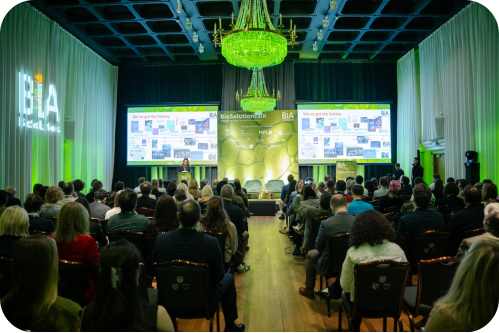
From decarbonising materials and food systems to restoring polluted land, the time for biosolutions is now. That message rang clearly throughout BioSolutions UK, the BioIndustry Association’s (BIA) flagship conference convening over 200 innovators, policymakers and industry leaders alongside an additional 29 investors around a shared goal: deploying biology to deliver a sustainable and secure future.
From fossil dependency to biological resilience
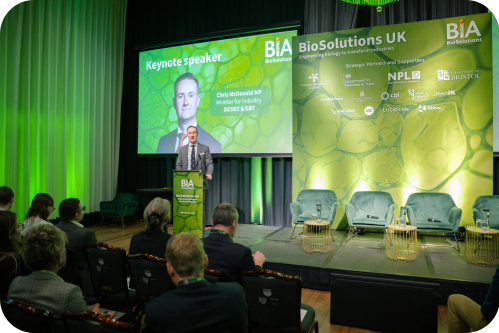
Opening remarks from Chris McDonald MP and Jane Wall, Managing Director of BIA, positioned biosolutions as a strategic response to today’s converging pressures: climate change, fragile global supply chains and resource volatility. Speakers underlined that biology is no longer confined to the lab; it is becoming a foundational industrial tool for producing food, materials and chemicals in ways that reduce emissions and tackle environmental harm. Minister McDonald noted that “the products developed by this industry will have a profound impact on people’s lives and the economy.”
Industry leadership perspectives reinforced that this transition is already underway. Tina Sejersgård Fanø, Executive Vice President at Novonesis, highlighted how biosolutions are already embedded in everyday life, delivering incremental biological improvements that are cutting waste and emissions at scale. Nonetheless, her optimism came with a precaution:
Companies are ready to scale the technology but unless we push for change we may see the fruits of European tech leadership being harvested in other regions.
From the investment standpoint, Anders Bendsen Spohr, Managing Partner and Head of Planetary Health Investments at Novo Holdings, emphasised the growing momentum behind biosolutions and the importance of aligning capital, policy and infrastructure to support companies through scale-up.
Since 2018, UK biosolutions companies have raised £1.46 billion, according to data from BIA BioSolutions, with investment reaching a new high in 2025 – clear evidence that these markets are attracting serious capital. Yet the message from the conference was unequivocal: Innovation must be matched with routes to scale, supportive policy and long-term patient capital.
And BioSolutions UK provided the launchpad for this need, with an exclusive, investor‑only breakfast, convening some of the most active and influential investors operating in biosolutions.
Sustainability in action: practical solutions today
Throughout the programme, speakers emphasised that biosolutions are already embedded in everyday life – often invisibly – through enzyme-enabled manufacturing, waste reduction in food systems and bio-based inputs replacing petrochemicals.
The innovation showcase brought these ideas to life through a cohort of standout startups: Fermtech, transforming spent cocoa grains and other agricultural residues through fermentation; Visibuilt, developing fungi‑based binders to replace fossil‑derived inputs in concrete; RemePhy, deploying engineered plant-microbe partnerships to remediate polluted land while recovering valuable metals; W’ICE, applying biological spray‑on antifreeze coatings to protect crops from frost; and Amplisynth, enabling on‑demand DNA printing to accelerate biological innovation.
Together, these companies demonstrated a unifying principle of the biosolutions sector: that working with nature rather than against it can simultaneously unlock performance gains, resilience and significant carbon savings.
Security, trust and responsible innovation
If sustainability is the ‘why’ of biosolutions, security is the enabler. A dedicated session on responsible innovation highlighted that robust biosecurity and regulatory frameworks are not barriers to growth, but competitive advantages. Designed well, they reduce risk, protect supply chains and build confidence among investors, partners and the public.
Panellists – spanning biosolutions and biosecurity screening, investor and Government perspectives, including Croda, Ribbon Bio, SeaX Ventures and DSIT – made clear that investors are looking for clarity and predictability. Uncertain or fragmented regulatory pathways in some area, particularly where UK, EU and US approaches diverge, can stall development and drain capital. Clear, proportionate guidance signals maturity in the ecosystem and unlocks private investment.
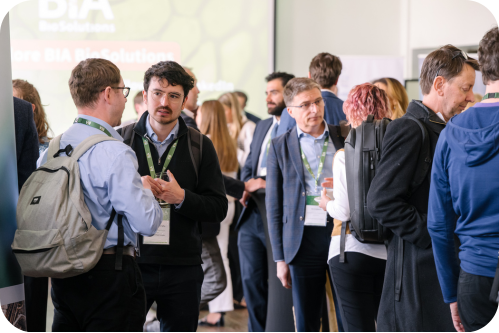
Scaling sustainably: infrastructure as a security issue
A recurring challenge across the day was scale-up infrastructure. Limited access to affordable fermentation capacity, grid energy and specialised facilities threatens the UK’s ability to retain and grow biosolutions businesses domestically. Speakers from across the UK and Europe argued that infrastructure gaps are not just operational risks – they are strategic vulnerabilities that could undermine sustainability ambitions and economic security alike.
Addressing this requires holistic planning, earlier intervention and an industrial strategy aligned with the needs of SMEs. Collaboration – across regions, sectors and borders – was repeatedly highlighted as the mechanism through which these systemic barriers can be overcome.
Two standout sessions made the theme of collaboration feel especially tangible: ‘Inside the deal’ offered a rare, candid look at how startups and multinationals structure successful partnerships, while ‘Reverse pitching’ flipped the script by having major buyers share what they actively need from biosolutions innovators. Inside the deal highlighted regulation, a key theme of the day, with Daniele Leonarduzzi, Senior Scientist II at Reading Scientific Services, saying:
I am sympathetic towards regulators, whose challenge is regulating the products of the future. As industry, we need to work with them to push for the right pathway, and the UK is already leading on this.
A shared mission for the bioeconomy
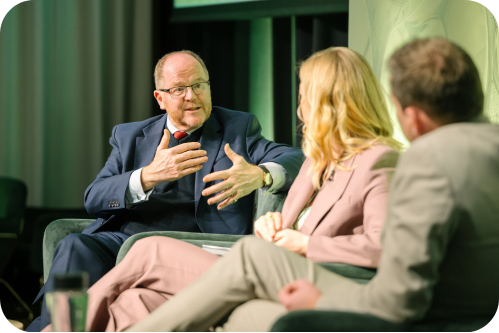
In closing reflections, speakers including George Freeman MP, stressed that no single company, country or sector can deliver the bioeconomy alone. Sustainability and security are collective challenges, demanding shared standards, harmonised regulation and open collaboration between innovators, investors, corporates and governments. That sentiment was captured succinctly when Sofie Carsten Nielsen. Director of DI Biosolutions and European Biosolutions Coalition, said:
It’s not back to the future; it’s back to nature.
We would like to give a special acknowledgement to all our speakers, sponsors and exhibitors for making this year special, and extend our thanks to all attendees. A special mention also goes out to participants in the UK Future Talent poster competition, giving postgraduate students and early‑career researchers the opportunity to showcase their engineering biology research.
If your company wants to become a part of this incredible movement, join BIA BioSolutions today.