Forewords

Chris Molloy
Chief Executive, UK BioIndustry Association (BIA)
Contract manufacturing is a critical component for all life sciences companies, and particularly for those with high-value, complex and precision drugs.
All BIA members who discover and develop new, increasingly advanced, therapeutics need reliable, collaborative and well-regulated sources of manufacture for their clinical trials. Those who succeed in the clinic, regulatory approval and procurement then need scalable manufacture suitable for UK and global markets.
Manufacturing itself is a strategic UK industry, creating well-paid, multi-skilled jobs and fostering supply chains many times larger than the manufacturers themselves.
Many BIA members manufacture these high-value medicines for themselves and for others, acting as contract development and manufacturing organisations (CDMOs). Until now, there has been no single picture of what biological medicines the UK can make under contract, and what it cannot. This report changes that. It is a snapshot of proven capability, drawn from 23 organisations across 31 sites, and much of it is good news. The UK is particularly strong in cell and gene therapies, and more organisations are working towards GMP licences.
It also shows two clear gaps. No UK organisation makes oligonucleotides to GMP, and none offers live attenuated viral vaccines as a contract service. In a future pandemic, those gaps would matter.
I thank BIA's Manufacturing Advisory Committee, chaired excellently by Dr Kit Erlebach, and our evergreen sector expert Annette England MBE, for working across the UK to collate and curate this 'living list', which we will keep up to date. I hope our stakeholders across government and developers alike find it useful.

Kit Erlebach
Chair, BIA Manufacturing Advisory Committee, and Senior Director, Engineering and EHS, Fujifilm Biotechnologies
From the Manufacturing Advisory Committee's perspective, these findings highlight both the depth of the UK's manufacturing expertise and the need to strengthen the route from clinical development to commercial supply. For our manufacturing community, the task is to build on those strengths and address the gaps.
Developers choosing a UK partner can plan for commercial scale and this report enables them to be clear about the capabilities available. Commercial CDMOs, NHS and university facilities, and the Catapults each have distinct, complementary roles, bringing together development and manufacturing expertise, specialist capabilities and support to bridge the gap between research and commercial production.
As a Committee, we want this report to support informed partnerships and constructive collaboration across that community. We invite eligible organisations not yet listed to get in touch and contribute their capabilities, so that future editions provide as complete and useful a picture of UK manufacturing as possible.
Introduction
Most biotechs don't own a factory. When a new medicine needs making for a clinical trial, or for patients once it's approved, they turn to a contract development and manufacturing organisation (CDMO). CDMOs make medicines on behalf of the companies that discover them.
This report sets out what UK CDMOs can make today, and where the gaps are. It draws on information supplied by 23 organisations across 31 UK sites between May and September 2026. It covers what they make (the active ingredient, known as drug substance, or the finished product, known as drug product), the types of medicine they handle, whether they work at clinical or commercial scale and which regulators they have released products to.
We've written it for three groups:
- government, particularly the Office for Life Sciences (OLS), to support work on pandemic preparedness and health resilience
- medicine developers in the UK and overseas looking for a UK manufacturing partner
- anyone making the case for UK manufacturing, as a dated baseline to cite in consultations and policy work
Until now there has been no single published resource covering UK contract manufacturing across all types of medicine. This report is a first step, and we will update it as capability changes.
What this report covers
This report is a snapshot of proven UK capability. It includes only GMP manufacture of medicines for human use that organisations carry out now, or have carried out, at a UK site. It does not include capability an organisation could develop if needed, as many did during COVID-19.
Types of medicine follow the categories used by the Medicines Manufacturing Industry Partnership (MMIP). Each is counted as a type of medicine in its own right. For example, oligonucleotide medicines are counted separately from DNA medicines, and live attenuated vaccines separately from other vaccines.
Alongside commercial CDMOs, the report includes NHS and university facilities and two research and technology organisations (RTOs), the Cell and Gene Therapy Catapult and CPI. These are shown separately.
BIA and its Manufacturing Advisory Committee approached 35 organisations. Each described its own capabilities using a standard form, and we checked any unclear answers with the organisation. We have not otherwise verified the information independently. 23 organisations are included. Six did not respond by the time of writing, and six were not eligible, for example because they make research-grade material only or are still waiting for a GMP licence.
The figures count organisations, not capacity. A site that makes one batch a year counts the same as one that makes hundreds.
This is a starting point, not a finished picture. We will ask contributors to check and update their details every 12 months.
Key findings
The UK has a broad base of proven manufacturing capability, particularly in cell and gene therapies. More organisations are working towards GMP manufacture. Two clear gaps stand out: oligonucleotides and live attenuated viral vaccines.
What the UK has
- Cell and gene therapy is the UK's deepest area. Nine organisations make these therapies, and five do so at commercial scale. Two of those five are part of the NHS and one is the Cell and Gene Therapy Catapult.
- Filling and finishing is widely available. In total, 16 organisations formulate, fill or finish medicines. For some types of medicine, such as oligonucleotides and live viral vaccines, that is the only UK capability.
- Commercial-scale antibody and protein manufacturing rests on two sites: Fujifilm Biotechnologies in Billingham and Lonza in Slough.
- NHS and university facilities play a big part. NHS Blood and Transplant, the Scottish National Blood Transfusion Service, King's College London and the University of Oxford's Clinical Biomanufacturing Facility make up four of the 23 organisations, and much of the UK's cell therapy capacity.
Working towards GMP
- More capability is on the way. Sheffield's Gene Therapy Innovation and Manufacturing Centre expects its GMP licence in 2027, and other organisations are building towards GMP manufacture.
Two clear gaps
- No organisation reports making oligonucleotides to GMP standard in the UK. Five can formulate and fill them, but the active ingredient has to be made elsewhere.
- None of the CDMOs that responded makes live attenuated viral vaccines. Five can fill them. Some vaccine developers make their own, but none offers this as a contract service.
What the data show
Strengths
The UK's depth is in advanced therapies and nucleic acids. Six organisations make RNA and eight make gene therapies, with a further five filling RNA products made elsewhere. That means 11 organisations work with RNA in some way. London, Oxford, Stevenage, Bristol, Liverpool and Edinburgh have long-standing expertise in viral vectors and cell therapy.
Commercial scale
Moving from trials to supply is where the UK thins out. For monoclonal antibodies, the medicines behind many of today's biggest treatments, two organisations make the active ingredient at commercial scale. No organisation reported making the active ingredient for microbiome or phage therapies at commercial scale.
Making vs filling
In total, 16 organisations fill and finish medicines. For some types of medicine, filling is all the UK offers. Oligonucleotides are the clearest case: no UK organisation makes them to GMP, but five can fill them. Live attenuated viral vaccines are the same. A developer may be able to finish a product here and still need to import what goes into it.
NHS and university facilities
NHS Blood and Transplant, SNBTS, King's College London's Gene Therapy Vector Facility and the University of Oxford's Clinical Biomanufacturing Facility make up four of the 23 organisations listed. Two of the five organisations making cell and gene therapies at commercial scale are part of the NHS.
Research and technology organisations
For this report, the Cell and Gene Therapy Catapult and CPI are classed as research and technology organisations rather than CDMOs. Both are part of the Catapult network set up by Innovate UK, and both offer collaborative process development, scale-up and GMP manufacturing facilities.
Working towards GMP
Some organisations are building GMP capability and will be added as they gain their licences. Sheffield's Gene Therapy Innovation and Manufacturing Centre, one of the LifeArc and MRC-funded gene therapy innovation hubs, expects its GMP licence in 2027. Others make research-grade material today. If your organisation is working towards GMP manufacture, we'd like to hear from you.
Working together
UK CDMOs work with each other and with NHS and academic facilities, with one making early-stage material and another taking it on to later trials and launch. For example, in November 2025 eXmoor Pharma and Royal Free London's Cell and Vector Innovation Centre agreed to give cell and gene therapy developers a joined-up route from early-phase manufacture through to later clinical and commercial supply.
What this means
For resilience, knowing the gaps matters as much as knowing the strengths. In a future pandemic, the UK would need to make vaccines and treatments at volume, quickly. Today, that depends on a handful of commercial-scale sites, and for some types of medicine, on manufacturers overseas.
The gaps also show where the UK risks losing products as they grow. A therapy trialled here may still be made abroad once it's approved, taking jobs and investment with it.
To address this and strengthen UK manufacturing capability, BIA's ongoing policy influence work continues to advocate for a range of measures:
- make capital grants such as the Life Sciences Innovative Manufacturing Fund more accessible for smaller companies
- build life sciences expertise within the National Wealth Fund and lower its minimum investment size
- prioritise UK–EU mutual recognition of batch testing in negotiations with the EU, removing a key trade barrier
- bring industrial energy costs in line with competitor countries
- invest in advanced manufacturing skills
Where UK CDMOs are
Scotland has the largest cluster, with six of the 31 sites. London and the South East have eight between them, and the Cell and Gene Therapy Catapult's two centres are in Stevenage and Braintree, in the East of England. None of the GMP sites is in Cambridge.
See the full map, with every site listed by region.
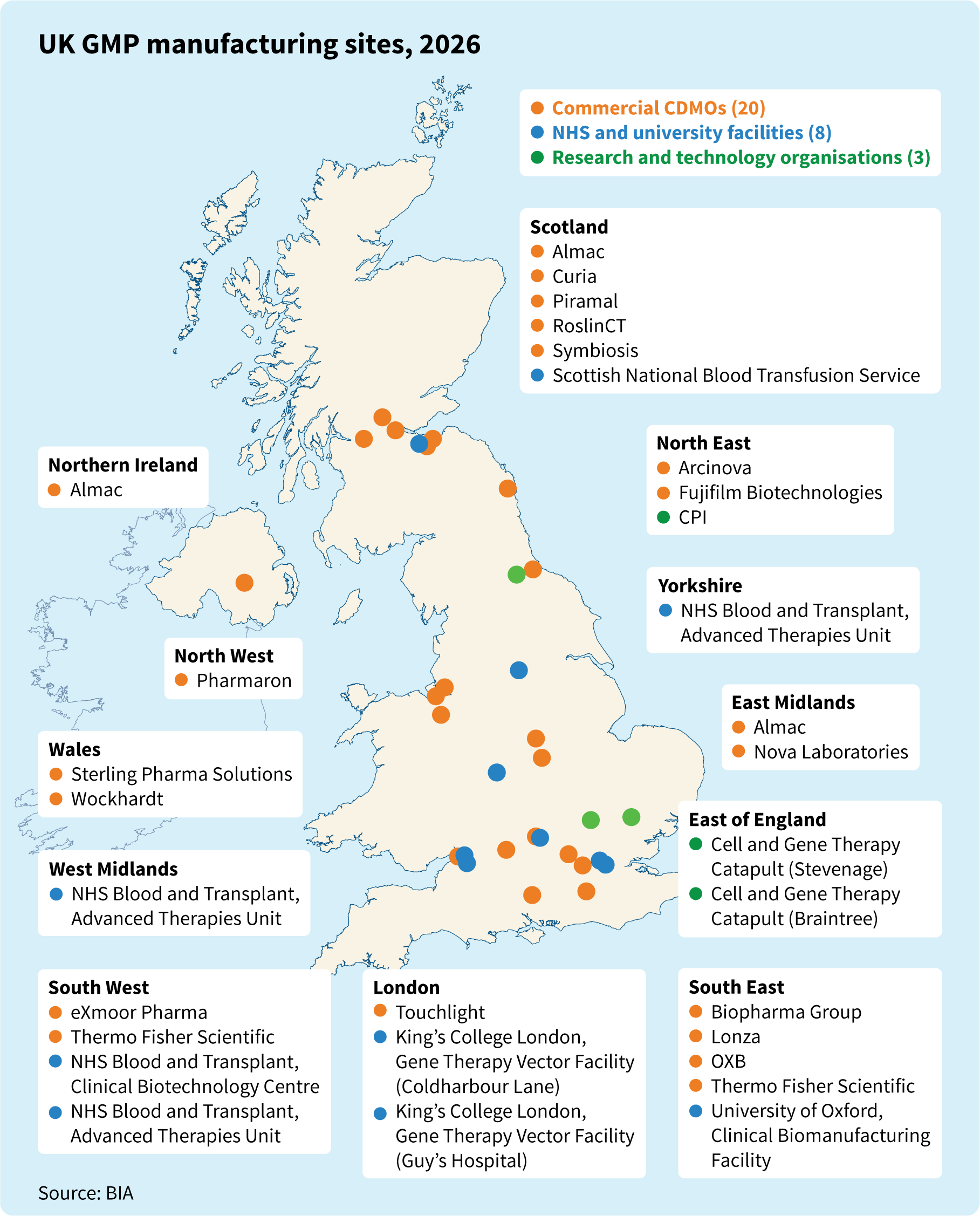
UK CDMOs and RTOs
The organisations below are listed in alphabetical order. Details are as supplied by each organisation and cover UK sites only. "Makes" means the organisation manufactures the active ingredient; "Fills" means it formulates, fills or finishes the product.
Almac
Almac Group provides a range of expert services and support across the drug development lifecycle, from R&D, diagnostic services, API manufacture and formulation development through clinical trial supply to commercial-scale manufacture and distribution. A privately owned organisation, Almac has grown organically over the past five decades.
- Website: almacgroup.com
- UK sites: Craigavon, Northern Ireland; Edinburgh, Scotland; Charnwood, Loughborough, East Midlands
- Type: Commercial CDMO
- Manufacturing: Drug substance, drug product, packaging and labelling
- Makes: RNA and ADC linkers (Craigavon); peptide vaccines and radiopharmaceuticals (Edinburgh)
- Fills: Drug product, packaging and labelling (Craigavon and Charnwood), including packaging and labelling for gene therapies
- Stage: Clinical and commercial (RNA: clinical)
- Regulators: MHRA, FDA and authorities in the Eurasian Economic Union, Russia, Kazakhstan, South Korea, Colombia, Brazil and Turkey
Arcinova
Arcinova
Arcinova provides innovative research, development and manufacturing services to advance drug development. We offer a comprehensive range of integrated specialist services for early-stage drug development, underpinned by strong industry knowledge and scientific expertise. Through a focus on quality, science and innovation, we empower biotech and pharma to bring life-changing therapies to patients faster.
- Website: arcinova.com
- UK sites: Alnwick, North East
- Type: Commercial CDMO
- Manufacturing: Drug substance and drug product
- Makes: RNA (mRNA and saRNA), from linearised DNA template to fill-finish drug product
- Fills: Oligonucleotides (formulation development and fill-finish)
- Stage: Preclinical and early-phase clinical
- Regulators: MHRA, EMA, FDA
Biopharma Group
Biopharma Group is a global CDMO with more than 30 years of experience supporting pharmaceutical and biotech companies in the development and manufacture of liquid and freeze-dried products. In addition to freeze-drying, we offer formulation development, liquid fill-finish, packaging and stability studies, and produce batches for clinical trials.
- Website: biopharmagroupcdmo.com
- UK sites: Winchester, South East
- Type: Commercial CDMO
- Manufacturing: Drug product, packaging and labelling
- Makes: –
- Fills: Liquid and freeze-dried products across most medicine types, including RNA, vaccines, cell and gene therapies, recombinant proteins, monoclonal antibodies, VLPs, oligonucleotides, ADCs, radiopharmaceuticals and microbiome and phage
- Stage: Clinical
- Regulators: UK, EU
Cell and Gene Therapy Catapult
The Cell and Gene Therapy Catapult is an independent, not-for-profit research and technology organisation set up in 2012 to grow the UK cell and gene therapy industry. Its Manufacturing Innovation Centres help developers establish and scale GMP manufacture of advanced therapy medicinal products (ATMPs) through a collaborative model that differs from a CDMO: collaborators run their own processes in segregated cleanroom modules and retain full ownership of their process and product IP, supported by the Catapult's licensed infrastructure, GMP warehousing, QC and regulatory expertise.
- Website: ct.catapult.org.uk/capabilities/manufacturing-innovation
- UK sites: Stevenage and Braintree, East of England
- Type: Research and technology organisation (RTO)
- Manufacturing: Drug substance, drug product, packaging and labelling (both sites)
- Makes: Stevenage: cell therapy, gene therapy, viral vector vaccines and VLPs. Braintree: cell therapy, gene therapy, viral vector and recombinant protein vaccines, recombinant proteins, monoclonal antibodies and VLPs. Both sites handle genetically modified viruses at BSL2 or below.
- Fills: –
- Stage: Stevenage: clinical and commercial. Braintree: clinical.
- Regulators: MHRA licenses both sites. Product made at Stevenage has been supplied under collaborators' own authorisations to UK, EU and US markets.
CPI
The Centre for Process Innovation (CPI) is the UK's leading independent technology and innovation centre, supporting the development, scale-up and manufacture of biologics, RNA and advanced therapies. CPI provides end-to-end biomanufacturing capability, from process and analytical development through to GMP manufacture, with specialist facilities spanning microbial, mammalian and cell-free systems.
- Website: uk-cpi.com
- UK sites: Darlington, North East
- Type: Research and technology organisation (RTO)
- Manufacturing: Drug substance
- Makes: RNA, vaccines, recombinant proteins, VLPs, microbiome and phage
- Fills: –
- Stage: Clinical
- Regulators: UK; targeting Europe and US
Curia
Curia is a global CDMO with over 30 years of experience successfully guiding clients through the complexities of drug discovery, development, and manufacturing. We offer services across Small Molecule, Generic APIs, Sterile Drug Product and Biologics backed by deep scientific expertise and a robust global network of resources and capabilities. Our dedicated teams enable us to be both flexible and scalable, accelerating the delivery of your product to patients.
- Website: curiaglobal.com
- UK sites: Glasgow, Scotland
- Type: Commercial CDMO
- Manufacturing: Drug product
- Makes: –
- Fills: DNA, RNA, live attenuated and inactivated virus vaccines, recombinant proteins, monoclonal antibodies, VLPs, oligonucleotides, ADCs, microbiome and phage
- Stage: Clinical
- Regulators: MHRA, EMA, FDA, TGA (Australia), PMDA (Japan), MFDS (South Korea)
eXmoor Pharma
For over 20 years, eXmoor Pharma has been at the forefront of cell and gene therapy, supporting biotech innovators from early-phase development to full-scale GMP manufacturing. Our unique blend of consultancy and CDMO expertise means we don't just manufacture—we provide strategic guidance to ensure therapies are commercially viable from day one. We combine CMC consultancy, process development, analytical services and GMP manufacturing to provide comprehensive support across Viral Vectors, Autologous and Allogeneic Cell Therapies, and RNA technologies. This integrated model enables seamless progression from early-phase strategy through to commercial readiness. With a 70% repeat business rate and 190+ clients worldwide, we are more than a service provider—we are your long-term partner in success.
- Website: exmoorpharma.com
- UK sites: Bristol, South West
- Type: Commercial CDMO
- Manufacturing: Drug substance, drug product, packaging and labelling
- Makes: RNA, cell therapy, gene therapy, VLPs
- Fills: –
- Stage: Clinical
- Regulators: MHRA; EU planned
Fujifilm Biotechnologies
Fujifilm Biotechnologies is a global CDMO with sites in the UK, US, Denmark and Japan. Its Billingham site in Teesside provides GMP drug substance manufacture of recombinant proteins, monoclonal antibodies, vaccines and VLPs at clinical and commercial scale, with process development across a wider range of medicine types.
- Website: fujifilmbiotechnologies.fujifilm.com
- UK sites: Billingham, North East
- Type: Commercial CDMO
- Manufacturing: Drug substance
- Makes: Vaccines, recombinant proteins, monoclonal antibodies, VLPs, DNA and RNA
- Fills: –
- Stage: Clinical and commercial
- Regulators: UK, EU, US, Japan
Gene Therapy Vector Facility, King's College London
The Gene Therapy Vector Facility (GTVF) at King's College London is a leading GMP viral vector manufacturing facility supporting both academic and commercial clients in the development of advanced therapies. Over a 20-year legacy, GTVF has delivered more than 120 GMP viral vector batches. The facility specialises in the GMP manufacture of lentiviral, retroviral and adeno-associated viral (AAV) vectors, supplied as either drug substance or drug product.
- Website: gtvf.org
- UK sites: London (Coldharbour Lane and Guy's Hospital)
- Type: NHS or university facility
- Manufacturing: Drug substance, drug product, packaging and labelling
- Makes: Gene therapy (lentiviral, retroviral and AAV vectors), cell therapy
- Fills: –
- Stage: Preclinical and clinical
- Regulators: UK, Europe, US
Lonza
Lonza is a leading global CDMO supporting the development and manufacture of biologics, cell and gene therapies, and small molecules. In the UK, Lonza provides integrated early development, process development, and GMP manufacturing capabilities for biologics, helping biotechnology and pharmaceutical companies de-risk and accelerate programmes from candidate selection through to clinical and commercial supply.
- Website: lonza.com
- UK sites: Slough, South East (GMP manufacturing). Lonza also has an early development site in Cambridge.
- Type: Commercial CDMO
- Manufacturing: Drug substance
- Makes: Monoclonal antibodies, recombinant and complex proteins, ADCs
- Fills: –
- Stage: Early clinical (Phase I and II) and niche commercial
- Regulators: MHRA, FDA, EMA, with international submissions supported through Lonza's biologics network
NHS Blood and Transplant
NHS Blood and Transplant's Cellular and Molecular Therapies function supports the development, manufacture, testing, storage and clinical delivery of cell and gene therapies across the UK. With over 20 years' experience, NHSBT provides integrated GMP manufacturing, analytical testing, cryopreservation, logistics and clinical trial support, helping academic, biotech and commercial partners translate advanced therapies from research into clinical practice.
- Website: nhsbt.nhs.uk/cellular-and-molecular-therapies
- UK sites: Bristol (Clinical Biotechnology Centre and Advanced Therapies Unit), South West; Birmingham (Advanced Therapies Unit), West Midlands; Barnsley (Advanced Therapies Unit), Yorkshire
- Type: NHS or university facility
- Manufacturing: Drug substance, drug product, packaging and labelling
- Makes: DNA (GMP plasmid DNA and DNA vaccine plasmids) and gene therapy (lentiviral and AAV vectors) at the Clinical Biotechnology Centre; cell therapy at the Advanced Therapies Units
- Fills: –
- Stage: Clinical, and commercial for selected programmes
- Regulators: MHRA, EU
Nova Laboratories
Founded in 1994, Nova Laboratories Limited is a privately owned pharmaceutical company with a global reputation for excellence in complex sterile manufacturing. The company routinely performs liquid fill/finish operations, ranging from small, hand-filled batches to fully automated runs of up to 20,000 vials, making Nova an ideal partner for clinical trial material as well as commercial manufacturing.
- Website: novalabs.co.uk
- UK sites: Leicester, East Midlands
- Type: Commercial CDMO
- Manufacturing: Drug product, packaging and labelling
- Makes: –
- Fills: DNA, RNA, vaccines (viral vector, antigen and adjuvant), gene therapy, recombinant proteins, monoclonal antibodies, VLPs, oligonucleotides, microbiome and phage
- Stage: Clinical and commercial
- Regulators: MHRA, FDA, ANVISA (Brazil), PMDA (Japan), South Korea Ministry of Health, Saudi Arabia
OXB
OXB is a global, full-service, quality and innovation-led viral vector CDMO, with deep expertise in the development, scale-up and GMP-compliant manufacture of cell and gene therapy products. OXB was founded in 1995 as a spin-out from the University of Oxford, with a mission to harness the potential of gene and cell therapy to transform medicine.
- Website: oxb.com
- UK sites: Oxford, South East (four sites: Harrow House, Yarnton, Oxbox and Windrush Court)
- Type: Commercial CDMO
- Manufacturing: Drug substance, drug product, packaging and labelling, plus QC release, microbiology and sterility testing
- Makes: Gene therapy (lentiviral and other viral vectors), viral vector vaccines (ChAdOx)
- Fills: –
- Stage: Clinical and commercial
- Regulators: Inspected by MHRA, FDA, EMA, ANVISA, PMDA and MFDS. Released into the US, Switzerland, Germany, France and China.
Pharmaron
Pharmaron is a premier life science service provider that offers a broad spectrum of R&D and manufacturing service capabilities throughout the entire drug discovery, preclinical, clinical development, and commercialisation process. The Liverpool site is a cGMP manufacturing facility purpose-designed for protein therapeutics, viral vectors and vaccines.
- Website: pharmaron.com
- UK sites: Liverpool, North West
- Type: Commercial CDMO
- Manufacturing: Drug substance
- Makes: DNA, vaccines (including recombinant and viral vector), gene therapy, recombinant proteins, monoclonal antibodies, VLPs, microbiome
- Fills: –
- Stage: Clinical
- Regulators: MHRA, EMA, FDA, Japan, Health Canada, ANVISA (Brazil), South Korea
Piramal
Piramal Grangemouth operates as a CDMO site focused on complex drug substance development and GMP manufacturing, delivering biologics and ADC-related products through integrated, end-to-end project execution. Activities span process development, technology transfer and cGMP batch manufacture.
- Website: piramalpharmasolutions.com/facilities/grangemouth
- UK sites: Grangemouth, Scotland
- Type: Commercial CDMO
- Manufacturing: Drug substance
- Makes: ADCs
- Fills: –
- Stage: Clinical and commercial
- Regulators: MHRA, PMDA (Japan), MFDS (South Korea), Turkish Ministry of Health
RoslinCT
RoslinCT is a leading global CDMO focused on advanced cell therapies. It provides process and analytical development, clinical and commercial manufacturing for autologous and allogeneic cell therapies, as well as iPSC cell line development, gene editing and differentiation services. Founded in 2005, RoslinCT is built on the scientific heritage of the Roslin Institute.
- Website: roslinct.com
- UK sites: Edinburgh, Scotland
- Type: Commercial CDMO
- Manufacturing: Drug substance and drug product
- Makes: Cell therapy (autologous and allogeneic)
- Fills: –
- Stage: Clinical and commercial
- Regulators: UK, EU, US
Scottish National Blood Transfusion Service (SNBTS)
SNBTS has over 20 years' experience of developing and delivering autologous and allogeneic ATMPs for in vivo studies, First-in-Human, Phase 1 and Phase 2 trials. As an NHS establishment, we are uniquely positioned to offer end-to-end solutions from procurement of starting materials, in-process sterility and QC testing, to QP release of safe products for use within an NHS Clinical Research Facility.
- Website: at-tcat.nhs.scot
- UK sites: Edinburgh, Scotland
- Type: NHS or university facility
- Manufacturing: Drug substance, drug product, packaging and labelling
- Makes: Cell therapy, gene therapy (including genetically modified cell therapies)
- Fills: –
- Stage: Clinical and commercial
- Regulators: UK, EU (Spain)
Sterling Pharma Solutions
Sterling Pharma Solutions is a global contract development and manufacturing organisation (CDMO), specialising in complex and hazardous science. Our dedicated bioconjugation and ADC facility in the UK supports customers' projects from development to preclinical and clinical manufacture.
- Website: sterlingpharmasolutions.com
- UK sites: Deeside, Wales
- Type: Commercial CDMO
- Manufacturing: Drug substance
- Makes: ADCs and other biological drug conjugates
- Fills: –
- Stage: Preclinical and clinical
- Regulators: MHRA
Symbiosis
Symbiosis Pharmaceutical Services is a world-class CDMO and a specialist GMP aseptic fill-finish manufacturer of biopharmaceuticals for use in clinical trials and commercial sales globally. Symbiosis is MHRA-licensed and FDA-inspected and offers product development, GMP aseptic fill-finish of injectable drug products into vials, analytical testing, QP release, inspection, labelling, packaging and temperature-controlled storage and shipment of medicines.
- Website: symbiosis-pharma.com
- UK sites: Stirling, Scotland (four sites)
- Type: Commercial CDMO
- Manufacturing: Drug product, packaging and labelling
- Makes: –
- Fills: RNA, vaccines, cell therapy, gene therapy, recombinant proteins, monoclonal antibodies, oligonucleotides, ADCs
- Stage: Clinical and commercial
- Regulators: MHRA, FDA
Thermo Fisher Scientific
Thermo Fisher Scientific employs over 8,000 people across more than 30 UK sites. Swindon specialises in the production of sterile medicines, including liquid and freeze-dried drug products, supporting both clinical development and commercial supply. Horsham offers GMP and advanced therapies packaging, storage and distribution across clinical and commercial supply chains.
- Website: thermofisher.com
- UK sites: Swindon, South West; Horsham, South East
- Type: Commercial CDMO
- Manufacturing: Swindon: drug substance, drug product, packaging and labelling. Horsham: packaging and labelling.
- Makes: RNA and vaccines (Swindon)
- Fills: Sterile liquid and freeze-dried drug products (Swindon); clinical and commercial packaging and labelling for most drug product types (Horsham)
- Stage: Clinical and commercial
- Regulators: MHRA. Horsham has released clinical trial supplies into the UK and more than 50 other countries.
Touchlight
Touchlight has pioneered the field of synthetic DNA manufacture. We have established state-of-the-art manufacturing facilities at Hampton, London, with 11 GMP suites and a further four GMP-like suites. The facility is licensed by the MHRA. We operate as a CDMO manufacturing DNA for all genetic medicine modalities.
- Website: touchlight.com
- UK sites: Hampton, London
- Type: Commercial CDMO
- Manufacturing: Drug substance
- Makes: DNA
- Fills: –
- Stage: Clinical
- Regulators: MHRA, EMA, FDA
University of Oxford, Clinical Biomanufacturing Facility
The Clinical Biomanufacturing Facility at the University of Oxford is a CDMO for small-scale GMP batches for first-in-human and Phase 1/2 trials in the UK and overseas. It specialises in vaccine manufacture, with expertise in adenoviral vectors and other modalities.
- Website: cbf.ox.ac.uk
- UK sites: Headington, Oxford, South East
- Type: NHS or university facility
- Manufacturing: Drug substance, drug product, packaging and labelling
- Makes: Vaccines (ChAd and Ad5 viral vectors, OMV, recombinant protein and VLP vaccines), gene therapy viral vectors, recombinant proteins
- Fills: –
- Stage: Clinical (first-in-human and Phase 1/2)
- Regulators: UK and various African regulators
Wockhardt
Wockhardt UK specialises in sterile injectable drug product services covering a wide range of formats, including ampoules, lyophilised ampoules, vials and cartridges. These services are coupled with automatic visual inspection, packaging, full release testing and QP release from the site, serving UK, EU and rest of world markets.
- Website: wockhardt.co.uk
- UK sites: Wrexham, Wales
- Type: Commercial CDMO
- Manufacturing: Drug product, packaging and labelling
- Makes: –
- Fills: RNA, vaccines, recombinant proteins
- Stage: Clinical and commercial
- Regulators: UK, EU, rest of world
Get involved
We'll keep this report up to date. If you're a UK contract manufacturer, or working towards GMP manufacture, and want to be included, or your details have changed, contact Sam Cruickshank.